
Falling behind on your mortgage is frightening. But missing payments does not mean you have already lost your house.
The first thing you need to understand is not every possible foreclosure solution, but where you are in the process right now.
Once you know that, you can focus only on the options that still make sense for your situation.
First, Figure Out Where You Are
Two things can help you figure out where you are:
How long have you been behind?
and, often more importantly,
What documents have you received?
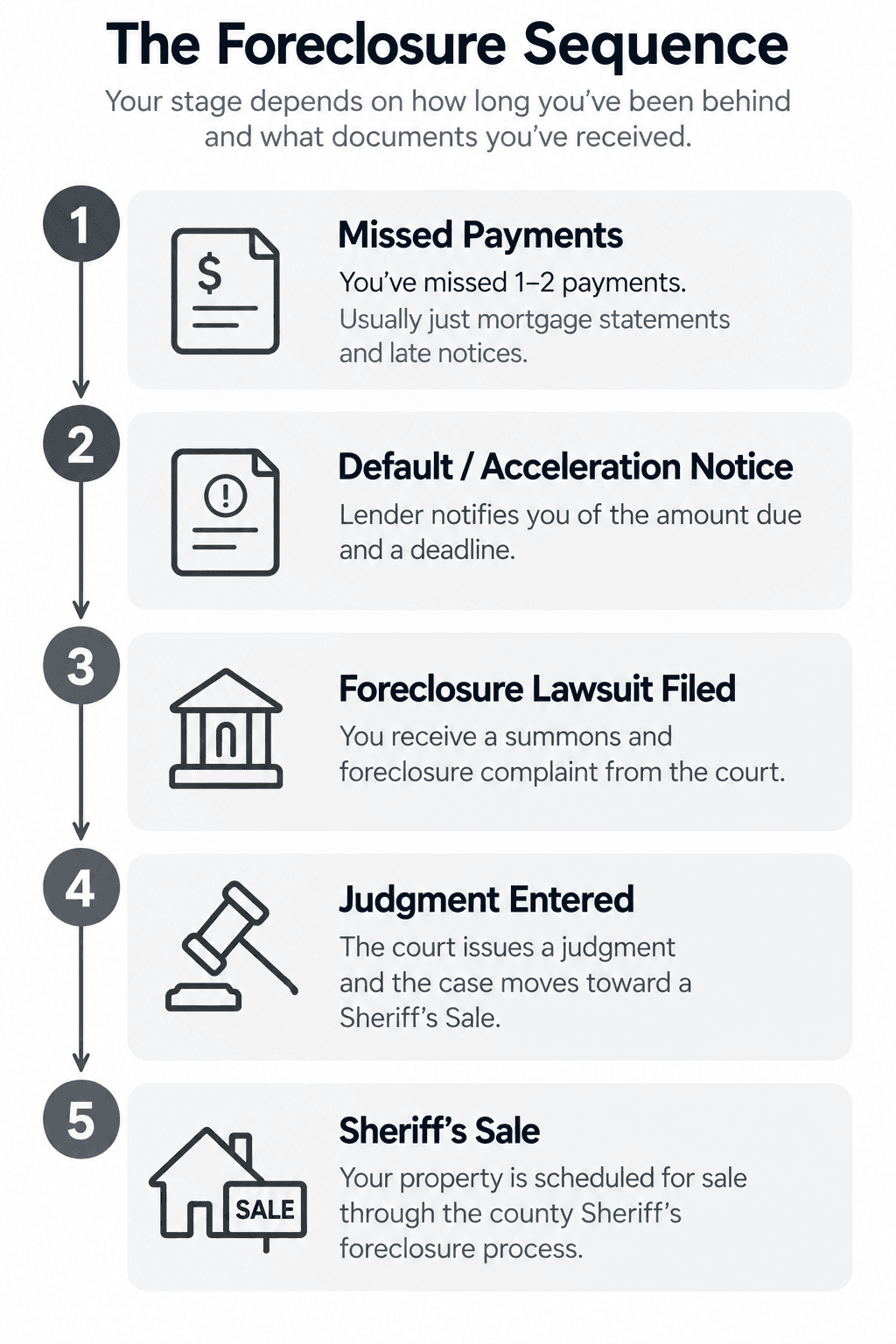
A homeowner who missed two payments is in a very different position from someone who has received a foreclosure complaint from the court. And someone with a Sheriff's Sale scheduled needs to think about the situation differently again.
At the federal level, a mortgage servicer generally cannot make the first filing required to start foreclosure until the loan is more than 120 days delinquent, subject to exceptions. (Consumer Financial Protection Bureau)
So if you recently started missing payments, you may still be before the formal foreclosure case.
But don't rely on the calendar alone.
Look at your mail.
Only getting mortgage statements and late-payment notices?
You may still be dealing primarily with the mortgage servicer rather than a foreclosure lawsuit.
At this stage, the important question is whether there is a realistic way for you to get the mortgage back under control.
Received a default or acceleration-related notice?
The situation is escalating.
Read the document itself carefully. Look for the amount required, any deadline, what the servicer says will happen next, and contact information for the mortgage servicer.
Do not assume every lender's notice gives exactly the same deadline or has the same legal effect.
Received a Summons and Foreclosure Complaint from a court?
That's different.
A foreclosure lawsuit has now been filed.
Once a foreclosure complaint arrives, the court process is underway and the deadlines matter.
Already have a judgment or Sheriff's Sale information?
You are further along.
Cuyahoga County foreclosure sales are conducted through the Sheriff's foreclosure-sale process. (Cuyahoga County Government)
At this stage, time matters considerably more than it did when you first missed a payment.
The important point is simple:
Don't describe your situation only as “I'm in foreclosure.” Find the latest meaningful document you received and identify what stage it represents.
That tells you much more about what matters next.
If You Can Still Keep the House, Start There
If your goal is to keep the house, that should be the first option you explore.
Then the next question isn't:
“Which foreclosure program should I apply for?”
It's:
“Is there a realistic path for me to afford this mortgage again?”
Maybe you were laid off but are starting a new job next month.
Maybe you have savings.
Maybe family can help you catch up.
Maybe your income dropped temporarily but has recovered.
Those situations are very different from having a mortgage payment that you simply cannot see yourself affording again.
If the problem is temporary, there may be ways to work with your mortgage servicer before deciding to give up the house.
You do not need to memorize all of the terminology. There are three concepts worth understanding.
Forbearance: “I need breathing room.”
Forbearance temporarily pauses or reduces mortgage payments.
It can be useful when the financial problem is temporary—for example, after losing a job—and you expect your situation to improve.
It doesn't cancel what you owe. You'll still need to repay any missed or reduced payments later. (Consumer Financial Protection Bureau)
So the question isn't merely:
“Can I pause my payments?”
It's:
“If I get some time, is there a realistic reason to believe I'll be able to afford the house again?”
If yes, forbearance may be worth exploring.
If no, additional time by itself may not solve the underlying problem.
Repayment plan: “I can afford the mortgage again—and a little extra.”
A repayment plan generally adds part of your past-due balance to your normal monthly payment for a period of time.
That can make sense if your income has recovered enough to handle both the regular payment and the additional catch-up amount. (Consumer Financial Protection Bureau)
If you still cannot afford the regular mortgage, spreading the arrears over several months doesn't fix that.
Loan modification: “I need the loan itself to become more affordable.”
A loan modification changes the terms of the mortgage. Depending on the modification, that can include changes intended to reduce the monthly payment.
But the important number is not whether a modification is offered.
It is:
What will my new payment actually be, and can I afford it? (Consumer Financial Protection Bureau)
That's the test for all of these options.
Don't ask only whether a solution can delay foreclosure.
Ask whether it leaves you with a mortgage you can realistically sustain.
Why Contact the Mortgage Servicer?
Because your servicer is the party that can tell you which foreclosure-prevention options, if any, are actually available for your loan.
Your servicer can explain the options available for your loan and whether any could make your mortgage manageable again. The goal is not simply to delay foreclosure—it is to find a realistic way to keep your home, such as a repayment plan, temporary payment relief, or a loan modification.
The purpose of the conversation is simpler:
“Is there a realistic option available through my mortgage that would allow me to keep this house?”
If the answer is yes—and the resulting payment is something you can actually afford—you may already have found the path you need.
You may not need the rest of this article.
What If You Don't See a Realistic Way to Keep the House?
Then the goal changes.
This does not mean:
“Give up and wait for foreclosure.”
It means you should stop evaluating every option solely by whether it keeps you in the house.
Now the question becomes:
How can I get out of this situation while I still have choices?
And one number becomes especially important:
How much equity do you have?
Imagine your house could sell for $220,000 and the mortgage payoff, including the amount you're behind, is $145,000.
There may be substantial value between those numbers.
That value matters.
Losing your home to foreclosure can seriously damage your credit. If selling is an option, it is typically better for your finances and your credit than letting the home go through foreclosure. (Consumer Financial Protection Bureau)
So before assuming “I can't afford the mortgage, therefore I'm losing the house,” understand the difference between:
losing the house to foreclosure
and
choosing to sell the house before foreclosure determines the outcome for you.
Those are not the same thing.
Can You Sell a House While You're Behind on the Mortgage?
Being behind on payments does not by itself mean you have lost ownership of the house or that a voluntary sale is automatically impossible.
But as foreclosure progresses, timing and the exact status of the case become increasingly important.
If you are considering selling, you can get a cash offer and see what selling before foreclosure could look like for you.
If you are considering selling, the basic financial picture is:
Likely sale proceeds minus mortgage payoff and other property-related obligations minus selling costs equals the approximate equity you may preserve
You don't need a perfect number to start understanding your position.
You need enough information to answer:
“Is there meaningful equity here that I should be protecting?”
Do You Need to Repair the House Before Selling?
Not necessarily.
And if foreclosure is already moving forward, spending significant time and cash renovating a property can create another problem: you may be investing money while your available time is shrinking.
There are different ways to sell.
A traditional listing may make sense when you have enough time, the property is reasonably marketable, and maximizing market exposure is the priority.
An as-is direct sale may make more sense when repairs, showings, preparation, uncertainty, or timing are bigger concerns.
Neither option is automatically right.
The question is:
Which one fits the amount of time you actually have and the condition of the house?
When Your House in Cash Becomes Relevant
If you've worked through the earlier options and keeping the house no longer looks realistic, this is where we can actually help.
Your House in Cash can evaluate the property in its current condition and provide a no-obligation as-is cash offer.
That offer is not an appraisal or a claim about the home's full market value.
It answers a narrower, practical question:
“What is one direct buyer actually willing to pay for this house as it sits today?”
You can compare that number with your mortgage payoff, your estimated equity, and other selling options before deciding what to do.
If selling to us isn't the right option, you don't have to accept the offer.
The Most Important Thing Is Knowing Which Problem You're Solving
If you just started missing payments, your problem may be:
“How do I get back on track?”
If you've received foreclosure court papers, it may be:
“What deadlines and options matter now?”
If you can no longer afford the mortgage, it may be:
“How do I protect my equity and get out before foreclosure takes away more of my choices?”
And if a Sheriff's Sale is already approaching, time may become the dominant issue.
You don't need every foreclosure solution at once.
Start by identifying where you are.
Then ask whether keeping the house is realistically possible.
If it is, focus on that.
If it isn't, understand the value you still have in the property and the options that remain before the foreclosure process makes the decision for you.